Our Guide to Public Rights of Way
Types of public rights of way
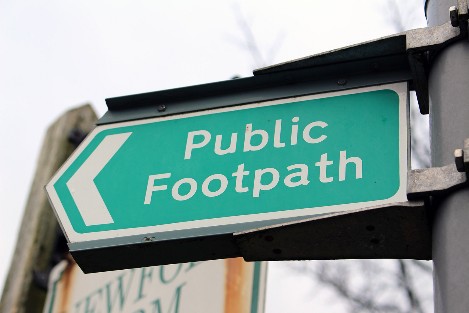
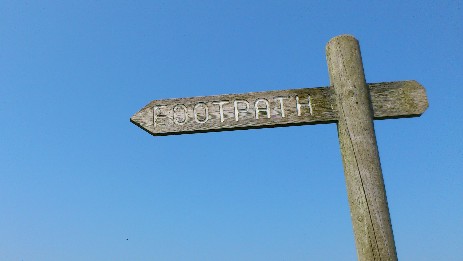
Footpaths are for walkers - including prams, pushchairs and wheelchairs - but remember that some paths, particularly those in the countryside, may not be suitable for them. Dogs are allowed on Public Footpaths although you may have to keep it on a lead or under close control.
There is no right to ride a cycle along a public footpath, although individual landowners may permit cycling on some routes which are public footpaths - and these are usually signed to indicate that cycling is permitted.


Restricted byways are for walkers, cyclists, horse-riders and horse-drawn vehicles.


How to find rights of way
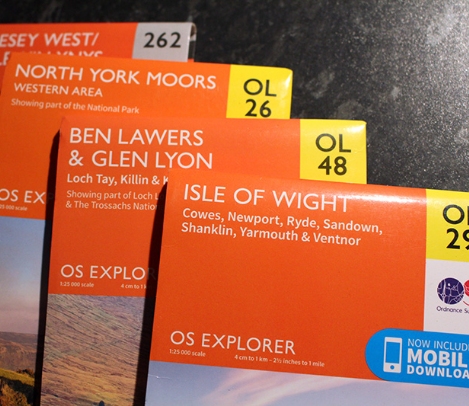
Ordnance Survey (OS) maps are the easiest way of finding out rights of way in a particular area. The most useful OS maps are Explorer series (1:25,000 scale) - these show all public rights of way in green, and permissive paths in orange. The Landranger series (1:50,000 scale) show public rights of way in red but doesn't show as much detail.
You can buy OS maps online here or if you just want to look at an area, Bing Maps have both 1:25,000 and 1:50,000 scale OS maps on their website.
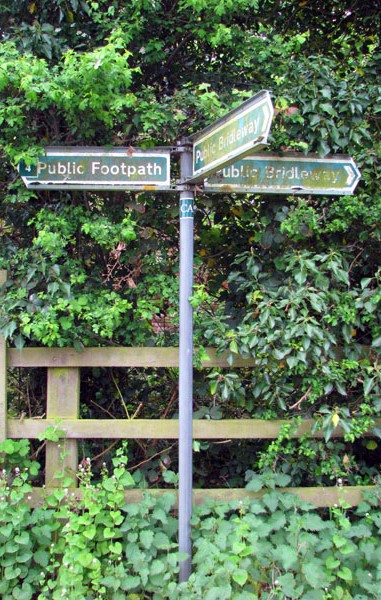
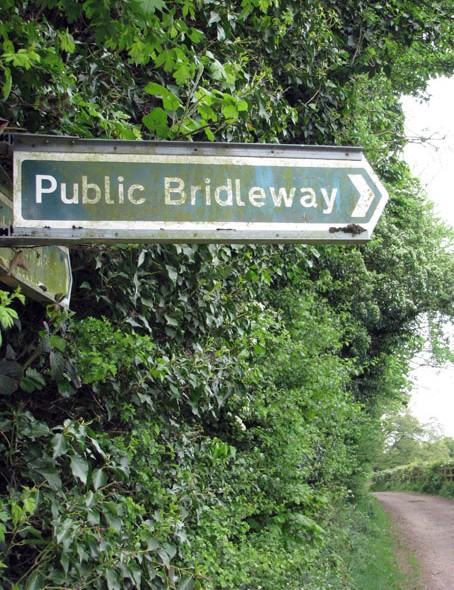
When you're out and about, rights of way are often signposted with the coloured arrows as described above - or with the familiar green finger signposts (blue, if the route is also a cycle route).
Does anyone have a definitive list of Public Rights of Way?
Problems in using a right of way
- the National Park Authority if it's in a national park
the local highway authority for land outside national parks - you can contact them through your local council - the Forestry Commission in woodland
Other types of rights of way
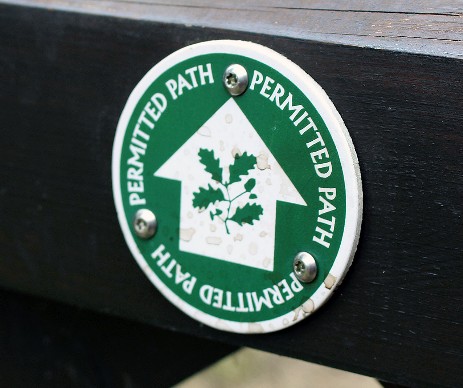
There are other types of paths - often called 'Concessionary', 'permissive' or 'permitted' paths. These are not public rights of way as of right, but are paths along which the landowner permits people to walk or ride. The permission may be limited to certain types of user, like only walkers. The permission may be a written agreement or just verbal and may be withdrawn by the landowner at any time.
Permissive paths will usually be closed for at least one day a year to ensure claims of a continous right of way can not be made against the landowner.
Rights of way in Scotland
In Scotland, a right of way is treated differently to those in England and Wales. A Scottish right of way is any route over which the public has been able to pass for at least 20 years and must link two public places, for example, a village, church or road.
Unlike England and Wales, Scottish local authorities don't have to signpost or mark a right of way or maintain a Definitive Map of Rights of Way in their area. Because of this - and Scotland's wider 'Right to Roam' - Ordnance Survey maps for Scotland don't show Rights of Way.

- Bicycles should not be taken onto public footpaths.
- Walkers are allowed to take dogs on Public Rights of Way, but they must be kept under close control - either on a lead or walking to heel.
- Dogs must not be allowed to run free accross fields or on land adjacent to the footpath.